
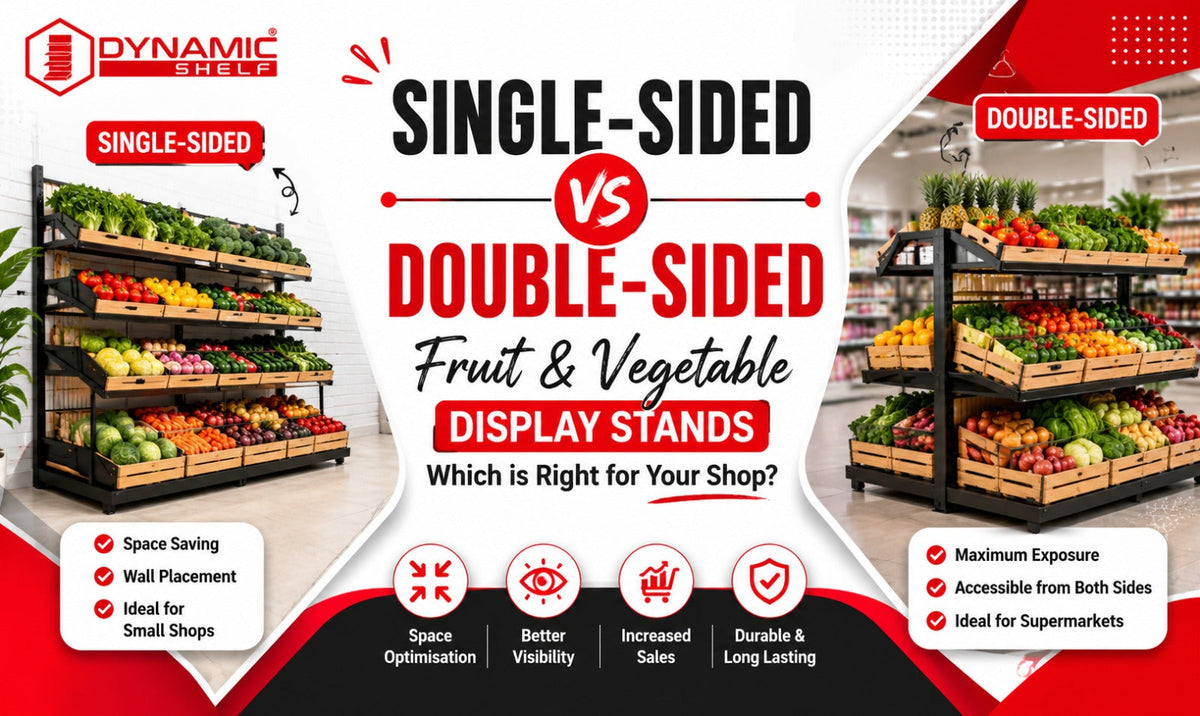
Single-sided fruit and vegetable display stands are designed for wall and perimeter placement, while double-sided stands sit in central floor space and allow customers to shop both sides simultaneously. Choosing the wrong configuration for your shop layout costs display capacity, disrupts customer flow, and ultimately affects how much fruit and veg you sell before it needs rotating.
Walk into any well-run convenience store or independent greengrocer in the UK and the fruit and veg section does two things before a customer has consciously noticed either of them. It signals freshness. And it moves people in a particular direction through the shop.
Both of those outcomes depend on the display stand not the produce itself. The wrong stand in the wrong position undermines both. The right one, positioned correctly, turns the fruit and veg section into the part of the shop that sets the tone for everything that follows.
The decision most retailers get wrong is not which produce to stock. It is which display configuration to choose before the stock arrives. Single-sided or double-sided is not a minor detail. It shapes the floor plan, the customer journey, and how much display capacity the shop actually has without necessarily taking more floor space.
Here is how to work it out before you order.
What the difference actually means in a working retail environment

A single-sided fruit and vegetable display stand has display shelves on one side only. It sits flush against a wall, a perimeter or a partition anywhere customers approach from one direction. A double-sided stand has display shelves on both sides, stands in open floor space, and customers shop both sides as they pass. The footprint is larger but the display capacity per square metre of floor space is significantly higher - two display faces from a single unit position.
The distinction sounds straightforward. In practice it gets complicated by floor space, aisle width, doorway access, customer flow, and the size of the fruit and veg range being displayed. Getting it wrong means either a stand that does not fit the space properly or one that underperforms because it is in the wrong position for the traffic it needs to generate.
Steel-framed stands with powder-coated finishes handle the daily cleaning, moisture, and repositioning that a busy fruit and veg section demands. A stand that looks good on delivery but deteriorates within a year of daily use costs more over time than the price difference suggests. Dynamic Shelf fruit and vegetable display stands are manufactured from powder-coated steel with a castor system rated for daily indoor and outdoor retail use, built to last in the kind of high-turnover environment where cheaper alternatives show their limitations quickly.
When single-sided is the right choice

Single-sided stands suit three specific retail situations better than a double-sided alternative would.
The first is a perimeter-led shop layout. Many UK convenience stores and off-licences run their product range around the walls of the shop with gondola units creating central aisles. In that layout, a single-sided fruit and veg stand is the natural fit, it extends the perimeter display into the produce category without disrupting the floor plan or breaking the visual continuity of the wall.
The second is a shop with limited floor space. Single-sided stands have a shallower footprint and a narrower depth overall - practical for retailers fitting units through standard shop doorways and positioning them in tight spaces without reducing aisle width. A double-sided stand in a narrow shop creates an obstruction. A single-sided stand against the wall does not.
The third is a shop where the fruit and veg range is relatively compact. A small section covering five to eight product lines does not need the display capacity of a double-sided stand. A single-sided three-shelf stand holds a focused range cleanly and visibly without looking underpopulated, which a larger double-sided unit would if the range does not fill it.
Dynamic Shelf single-sided mobile fruit and veg display stands stand 180cm high on lockable castors and are available in two-shelf and three-shelf configurations. The three-shelf version suits the majority of UK convenience store and greengrocer perimeter applications and is suitable for both indoor and outdoor use.
When double-sided earns its floor space

A double-sided stand costs more floor space than a single-sided one. It requires customers to be able to approach and shop from both sides simultaneously. That only works when three conditions are met and when they are, a double-sided stand consistently outperforms a single-sided alternative on sales per square metre.
The first condition is available central floor space. A double-sided stand belongs in the middle of a shop, not against a wall. If the floor plan has a natural island position near the entrance, at the end of an aisle, or in a dedicated fruit and veg section - a double-sided stand fills it efficiently and creates a display that customers encounter from multiple angles as they move through the shop.
The second condition is a fruit and veg range large enough to fill both sides without leaving empty shelves. Empty shelves on a double-sided stand are more damaging than on a single-sided one because they are visible from two directions. A full double-sided stand looks abundant. A half-stocked one suggests the shop has run out of produce, exactly the opposite of the impression a fresh fruit and veg section should create.
The third condition is customer flow that supports two-sided browsing. A stand positioned where customers only ever approach from one direction is wasting its second face. Position matters as much as the stand itself.
Dynamic Shelf's double-sided mobile fruit and veg display stand stands 180cm high and 120cm wide, with three tilted display shelves on each side, six display positions in total - on four castors (two swivel, two braked). The lockable castors mean the stand can be moved without emptying it first, which matters on a busy trading floor where repositioning for cleaning or restocking happens daily. A narrower double-sided configuration at 90cm wide is also available for shops where central floor space is available but aisle widths are tighter. Both are suitable for indoor and outdoor use.
The mirror stand: a third option most retailers overlook

There is a configuration that sits between the two and is consistently underused by UK retailers fitting out a new fruit and veg section.
Dynamic Shelf's single-sided fruit and veg display stand with mirror uses a mirrored back panel behind the display shelves. The mirror reflects the fruit and veg display, making the section appear deeper and the range appear fuller than it physically is. In a compact shop where a double-sided stand would be too large but a standard single-sided stand feels visually thin, the mirror stand bridges the gap.
It works particularly well in independent greengrocers and farm shops where the fruit and veg section is visible from the entrance and the first visual impression of the shop needs to read as abundant rather than modest. For a retailer who has invested in quality produce but has limited display space, this is the stand that makes the range look as good as it is.
The practical decision guide
Before choosing a configuration, answer four questions honestly about your shop:
Can customers physically walk around a central floor stand without the aisle feeling congested? If yes, double-sided is worth considering. If no, single-sided is the right call.
Does the fruit and veg range cover enough product lines to fill both sides of a double-sided stand during a normal trading day? If yes, double-sided. If no, single-sided or the mirror stand.
Is the stand replacing a wall fixture or creating a new central feature? Wall replacement - single-sided. New central feature - double-sided.
Is the shop entrance visible from the fruit and veg area? If yes, a double-sided stand near the entrance creates a strong first impression. If the entrance faces a wall, a single-sided mirror stand achieves a similar effect in less space.
FAQs
1. What is the difference between a single-sided and double-sided fruit and veg display stand?
A: A single-sided fruit and veg display stand has display shelves on one face only and sits against a wall or shop perimeter. A double-sided stand has shelves on both faces and stands in central floor space where customers can shop both sides as they walk past. Dynamic Shelf supplies both configurations in multiple sizes from stock at our Manchester warehouse, with the double-sided three-shelf stand being the most popular choice for UK convenience stores and supermarkets with open central floor space.
2. Which fruit and veg display stand is best for a small convenience store?
A: For most small UK convenience stores, a single-sided three-shelf mobile stand positioned along the perimeter wall is the most practical choice. It maximises display capacity without reducing aisle width or blocking customer flow. Dynamic Shelf single-sided stands stand 180cm high on lockable castors and suit shops where floor space is limited but the fruit and veg range still needs to look well-stocked and accessible throughout the trading day.
3. Can fruit and vegetable display stands be moved easily once positioned?
A: Yes. All Dynamic Shelf fruit and veg display stands sit on four-castor systems with two braked castors to lock the stand during trading hours and two swivel castors for easy movement. The braked castor design means the stand can be moved without emptying it first — practical in a busy shop where the stand needs repositioning for cleaning, restocking from the rear, or seasonal layout changes.
4. Do the display stands fit through a standard shop doorway?
A: Dynamic Shelf single-sided fruit and veg display stands have a shallow depth that passes through most standard UK shop doorways without difficulty, making them straightforward to bring into the shop and position without needing to partially disassemble the unit. If you have an unusually narrow doorway or access restriction, call 0161 792 9881 before ordering and the team will confirm the right configuration for your specific entry point.
5. Are fruit and vegetable display stands suitable for outdoor use?
A: Yes. Dynamic Shelf fruit and veg display stands are suitable for both indoor and outdoor use. The powder-coated steel frame and lockable castor system handle daily exposure to outdoor conditions, making them practical for retailers who move their fruit and veg display outside during trading hours or operate from a farm shop or market setting.
Dynamic Shelf fruit and vegetable display range
Dynamic Shelf manufactures and supplies the full range of mobile fruit and veg display stands directly to UK convenience stores, supermarkets, independent greengrocers, and farm shops from our Manchester warehouse. Single-sided stands in two-shelf and three-shelf configurations, the mirrored single-sided stand, and double-sided stands in two width options, all in stock, all suitable for indoor and outdoor use.
Collapsible vegetable baskets are available separately in two sizes and fit directly onto the tilted shelf system of every stand in the range.
Dynamic Shelf holds the full range in stock at our Manchester warehouse. Orders placed before 2pm are dispatched the same day for delivery across the UK within 2–5 working days. If the stand is needed sooner, same-day collection is available from our showroom at Unit 4 200 Waterloo Road, Manchester M88AE within 24 working hours of ordering.
Browse the full range at Fruit and Vegetable collection or call 0161 792 9881 to discuss which configuration suits your shop layout before you order.